
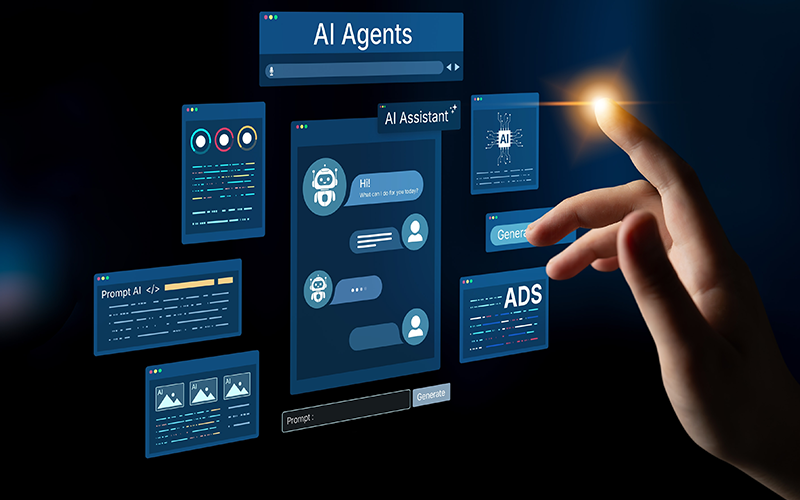
Artificial intelligence has already transformed how marketing teams create content. We believe the next transformation is not simply better prompts, it is better systems.
AI agents are moving beyond simple content generation to become autonomous participants in enterprise marketing operations. Instead of completing isolated tasks, they can coordinate complex workflows, execute repetitive processes and continuously improve productivity across the entire content lifecycle.
For marketing leaders, this represents a significant opportunity. However, it also introduces new operational challenges around governance, quality assurance and organisational control.
The organisations that gain the greatest advantage from AI agents will not simply automate content creation. They will redesign their content operations around intelligent, governed workflows.
The shift from AI tools to AI agents
Most marketing teams are already familiar with AI tools. An AI assistant responds to prompts, generates text and supports individual tasks. AI agents operate differently.
Rather than waiting for instructions, they execute predefined workflows across multiple stages of content production. For example, a single AI agent could:
- Monitor industry news.
- Identify trending topics.
- Conduct keyword research.
- Generate content briefs.
- Produce first drafts.
- Optimise for SEO.
- Prepare social media assets.
- Translate content.
- Submit work for editorial review.
- Schedule publication.
Instead of acting as a writing assistant, the agent becomes an operational team member. This evolution changes how marketing departments should think about content production.
Why content operations are becoming more complex
Creating content has never been the biggest challenge. Managing content at scale is. Today's enterprise marketing teams often produce:
- Blogs
- White papers
- Landing pages
- Case studies
- Email campaigns
- Sales enablement materials
- Product documentation
- Webinar content
- Social media assets
- Multilingual content
Each asset requires:
- Research
- Fact checking
- SEO optimisation
- Brand consistency
- Compliance review
- Stakeholder approval
- Localisation
- Performance analysis
These activities consume far more time than drafting content itself. Our survey of senior marketing leaders illustrates why organisations are searching for new approaches:
The pressure is operational rather than creative. Marketing teams need systems that help them manage increasing complexity.
Where AI agents deliver the greatest value
The greatest value of AI agents is often thought to be in writing faster. It isn’t. The real value comes in reducing operational friction.
AI agents can automate repetitive workflows including:
Research and topic discovery
Monitoring competitors, identifying emerging themes and recommending high-value content opportunities.
Content planning
Generating editorial calendars based on business priorities, search demand and campaign schedules.
Brief creation
Producing structured briefs containing:
- Target keywords
- Audience personas
- Search intent
- Internal linking recommendations
- Content outlines
SEO optimisation
Agents can recommend:
- Semantic keywords
- Content structure
- FAQ opportunities
- Internal links
- Metadata
- Schema suggestions
Content repurposing
Transforming long-form articles into:
- LinkedIn posts
- Email campaigns
- Video scripts
- Sales collateral
- Webinar summaries
Translation and localisation
Generating multilingual versions before passing them to native-language editors for review.
AI agents amplify operational efficiency
One AI agent can perform dozens of routine marketing activities every day. Multiple agents working together can coordinate entire production pipelines.
For example:
- Agent 1 researches topics.
- ↓
- Agent 2 builds the brief.
- ↓
- Agent 3 generates the article.
- ↓
- Agent 4 optimises SEO.
- ↓
Human editor reviews quality.
- ↓
- Compliance reviewer approves.
- ↓
- Publishing agent schedules release.
- ↓
- Performance agent monitors results.
This becomes an intelligent content operating system rather than a collection of disconnected tools.
Why human oversight becomes even more important
Autonomous systems increase scale, but they also increase risk. Our survey found that marketers continue to experience significant quality problems with AI-generated content:
If a single AI prompt produces one inaccurate article, the damage is limited. If autonomous agents generate hundreds of assets using the same flawed information, the impact multiplies rapidly.
This is why AI agents require structured governance. Human review remains essential for:
- Fact checking
- Brand governance
- Regulatory compliance
- Source validation
- Editorial quality
- Strategic judgement
Automation increases the need for oversight rather than eliminating it.
AI agents need governed workflows
Successful enterprise AI programmes combine automation with operational controls. These controls include:
- Editorial approval gates.
- Source verification.
- Brand guidelines.
- Compliance review.
- Version management.
- Audit trails.
- Role-based permissions.
Human sign-off before publication.
This governed approach ensures organisations benefit from automation without sacrificing quality.
As explored in Why AI content workflows need governance, governance should be viewed as operational infrastructure rather than administrative overhead.
AI agents improve continuously through human feedback
Unlike traditional workflows, AI agents can improve over time. Every editorial correction creates valuable feedback. Marketing teams can refine:
- Prompt libraries.
- Knowledge bases.
- Retrieval systems.
- Editorial rules.
- Brand guidance.
- Compliance checklists.
Human reviewers become trainers as well as editors. This continuous improvement model allows AI agents to produce progressively better outputs while maintaining organisational standards.
AI agents support multilingual content operations
Global organisations increasingly rely on AI agents to accelerate international expansion. Agents can coordinate:
- Translation.
- Localisation.
- Regional SEO.
- Market-specific landing pages.
- Product documentation.
- Campaign adaptation.
However, AI translation alone is insufficient. Native-language expert editors remain essential for validating:
- Technical terminology.
- Cultural relevance.
- Regulatory language.
- Brand tone.
- Local search intent.
For more on this topic, see:
AI localisation vs AI translation: what's the difference for B2B marketers?
How to scale multilingual content without building international marketing teams
Why native-language editors still matter in the age of AI translation
AI translation for SaaS companies expanding into Europe
How multilingual content improves AI search visibility and international SEO
AI search rewards governed content operations
AI-powered search engines increasingly prioritise content demonstrating:
- Expertise.
- Authority.
- Trustworthiness.
- Originality.
- Source quality.
Well-governed content operations naturally produce stronger quality signals because every asset benefits from structured review and continuous improvement. This makes governed AI workflows increasingly valuable for visibility across all AI-powered search engines.
How AI Refine transforms content operations
AI Refine extends the capabilities of AI agents by providing the governance layer required for enterprise publishing. Our platform combines:
AI-assisted content creation.
Human editorial review.
- Fact checking.
- Source verification.
- Brand governance.
- Compliance validation.
- Native-language localisation.
- Publish-ready quality assurance.
Rather than replacing human expertise, AI Refine enables organisations to scale autonomous content production while maintaining the standards expected by customers, regulators and search engines.
Frequently asked questions
What are AI agents in content operations?
How do AI agents differ from AI writing tools?
Can AI agents manage enterprise content operations?
Why do AI agents need human review?
Are AI agents suitable for regulated industries?
How do AI agents improve productivity?
Will AI agents replace content teams?
How does AI Refine support AI-powered content operations?
Final thoughts
AI agents have the potential to transform content operations by automating repetitive work, accelerating production and improving organisational efficiency. However, their true value is realised only when they operate within governed workflows that prioritise quality, compliance and editorial oversight.
The future of enterprise marketing is not defined by autonomous AI alone. It is defined by intelligent collaboration between AI agents and human experts, creating content operations that are faster, more scalable and fundamentally more trustworthy.